Holy Stubbornness Is a Spiritual Discipline
Nehemiah 6:3 so I replied by sending this message to them: “I am engaged in a great work, so I can’t come. Why should I stop working to come and meet with you?”
Holy- set apart, distinct, or separate from the common, unclean, or sinful- referring to God's unique, pure, and perfect nature, as well as things dedicated to His service, and a call for believers to be morally pure and separated from sin to reflect God's character. It signifies being whole, complete, and utterly different from anything earthly.
Stubbornness- dogged determination not to change one's attitude or position on something, to be resolutely fixed in one's opinions or course of action, refusing to change despite persuasion or good reasons
Holy Stubbornness is a Christian concept meaning an unyielding, resolute commitment to God's will, truth, and promises, even when facing worldly pressure or difficulty, often framed as a positive, persevering faith (like Jesus's unchanging purpose) rather than the negative biblical stubbornness (which is willful disobedience, a hardened heart, or self-centered rebellion)
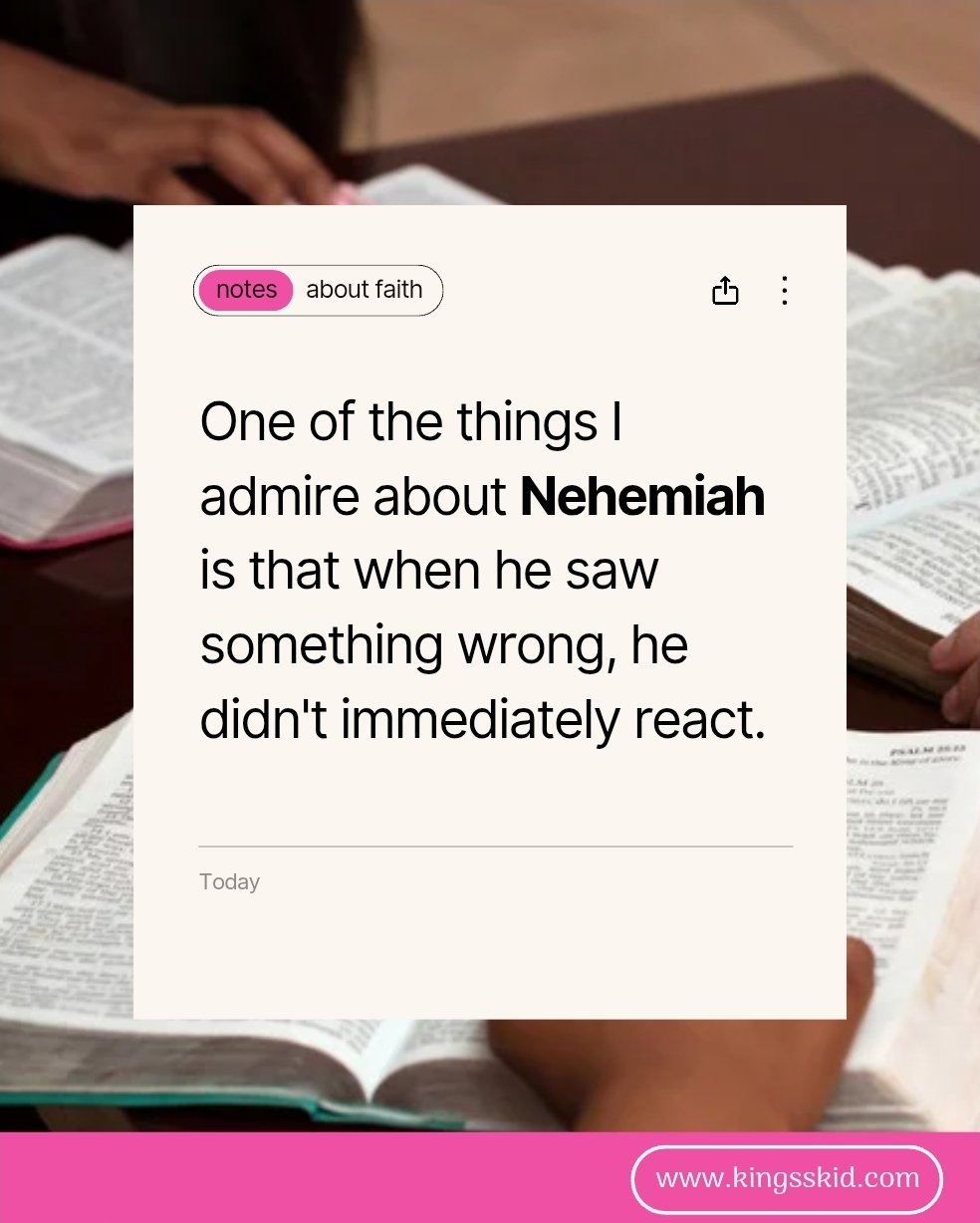
When Nehemiah speaks in Nehemiah 6:3, his "holy stubbornness" wasn't rooted in pride or self-importance—it was rooted in purpose. He understood that the work God had given him was too important to abandon.
The word stubborn often carries a negative meaning because it suggests refusing correction or being unwilling to listen. But Scripture also shows us that there is a righteous kind of stubbornness—a steadfast determination to obey God, protect His purposes, and remain faithful despite opposition.
When Nehemiah was rebuilding the walls of Jerusalem, he wasn't simply overseeing a construction project. The walls represented much more than bricks and stone. Their destruction had consequences that affected every part of the nation's life.
Some of the ramifications of the walls being down included:
Lack of security – Without walls, Jerusalem was vulnerable to enemy attacks, raids, and continual threats (physical vulnerability).
Loss of identity – In the ancient world, a city's walls symbolized its strength, dignity, and identity. Broken walls reflected the nation's broken condition.
Shame and reproach – The ruined walls were a public reminder of Israel's defeat and exile. The surrounding nations mocked God's people (see Nehemiah 1:3).
Interrupted worship – While the temple had been rebuilt, the city's instability made it difficult for the community to fully flourish in worship and covenant life.
Economic instability – A city without protection discouraged trade, commerce, and growth because people and goods were constantly at risk.
Fear and discouragement – Living without protection created an atmosphere of anxiety rather than confidence in rebuilding the community.
Compromised covenant community – The walls helped establish the boundaries of the holy city. Rebuilding them wasn't about isolation but about restoring a people set apart for God's purposes.
A weakened witness – Jerusalem was meant to display God's faithfulness to the nations. Its ruined condition communicated defeat rather than God's restoring power.
This is why Nehemiah refused to "come down." He understood that the assignment was bigger than he was. Every stone laid represented restored security, renewed hope, revived worship, and a renewed testimony of God's faithfulness.
The same principle applies today. There are some things believers should be "holy stubborn" about:
Remaining faithful to God's calling.
Protecting time with God in prayer and Scripture.
Guarding our integrity.
Preserving healthy boundaries.
Pursuing reconciliation when God calls us to it.
Refusing to compromise biblical convictions.
Finishing what God has assigned us to do.
Holy stubbornness is not resisting God—it is resisting everything that tries to pull you away from Him. It is the courage to say, like Nehemiah, "I am doing a great work, and I cannot come down."
We must be committed to not come down from some of our walls, and we must be discerning of the character of those who are asking us to come down from our walls. We know these people wanted Nehemiah to come down from the wall not to help but to distract, and this is why I can’t stress the importance of being discerning. Our problem is that we don’t build up our discernment to know, and then we are fooled and upset.
A team of financial investigators is trained to identify counterfeit currency. Instead of spending most of their time studying fake bills, they immerse themselves in the details of genuine currency—its texture, watermarks, security threads, micro-printing, and holograms. They handle authentic bills daily, memorize every feature, and understand how the real thing feels and looks. Because they know the authentic dollar so thoroughly, when they encounter a counterfeit—even if it’s a high-quality fake—they immediately notice subtle differences: the paper feels off, the ink doesn’t react to light correctly, or the watermark is missing. Their expertise in the real thing makes spotting the fake almost instinctive. The same should go for us studying God’s word and discerning the truth of God. Our second problem is the fact that we think we can come down from the wall and handle things in our own strength independent of God; we are not THAT GOOD. We have a false sense of confidence in our own strengths and abilities, but not Nehemiah.
He stayed on his assignment, he stayed on his post and prayed for strength when he was weak, and even encouraged others. If we are going to break barriers and build bridges on this CROWNED life journey, we must be willing to participate in the reconstruction process; the reconstruction process needs our undivided and unyielding attention. We must be willing to get dirty; you must be trustworthy; people must know they can trust you to allow you to have access to the innermost, dirty, and unrefined parts of their lives. In a holy stubbornness we are not only participants in the glory of being a bridge builder but we also have to willing to do the holy things, hard things and in between things, we don’t have the option to sit on a pedestal and pick and choose – it takes all of us, all of our gifting, skill,s talents, knowledge and strengths, tis not based off one person btu all of us.
God, thank you- thank you for allowing us to be participants of this holy work. Like Nehemiah, give us a holy stubbornness about the work and calling you have curated for us. Allow us to not create our own calves when you have curated a designated calling for us- God, allow us to be stubborn in the most holy and healthy way and not come from walls that we are assigned to, no matter how enticing it may be. Lord, allow us to be willing participants in the phases you have called us to break barriers, reconstruction, and building bridges, and while it may be heavy, Father, give us strength and grant us success in doing your good work. In Jesus’ Name, Amen.